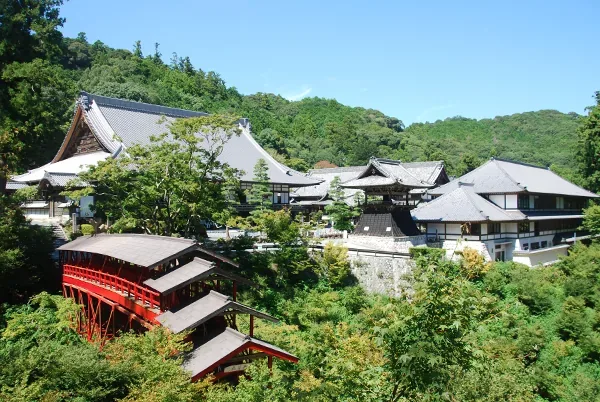
Hokoji is not a provincial temple but the seat of an entire Zen school. The Zen master Mumon Gensen, a son of Emperor Go-Daigo, founded it in 1371, and it heads the Hokoji branch of Rinzai Zen. Its grounds run to more than 60 hectares of forest in the mountains behind Hamamatsu, roughly 13 times the area of the Tokyo Dome. Among the trees stand 22 buildings registered as Tangible Cultural Properties, and 500 stone rakan, each with its own face, line the mountain path. Faith and forest have held this ground together for six and a half centuries.
The whole of it can be built to order as a corporate retreat. Zazen, seated Zen meditation, pulls attention back to the breath; copying sutras and tracing Buddhist images slow a person down stroke by stroke. A night in the temple lodging takes a team out of a hotel and into the temple's own rhythm. Meals are shojin ryori, or Buddhist cuisine, and the house dish gives vegetarian ingredients the texture of eel, served as shojin unagi-ju, so eating becomes part of the practice as well. None of this is sightseeing. It is a chance for a team under pressure to genuinely stop and realign.
Stillness is now the scarcest thing of all. For a team, going into the head temple of a Zen school to sit and breathe, copy a passage of sutra, eat a vegetarian meal and sleep a night inside the temple carries more weight than any luxurious itinerary. What it offers is not scenery. It is slowing down.