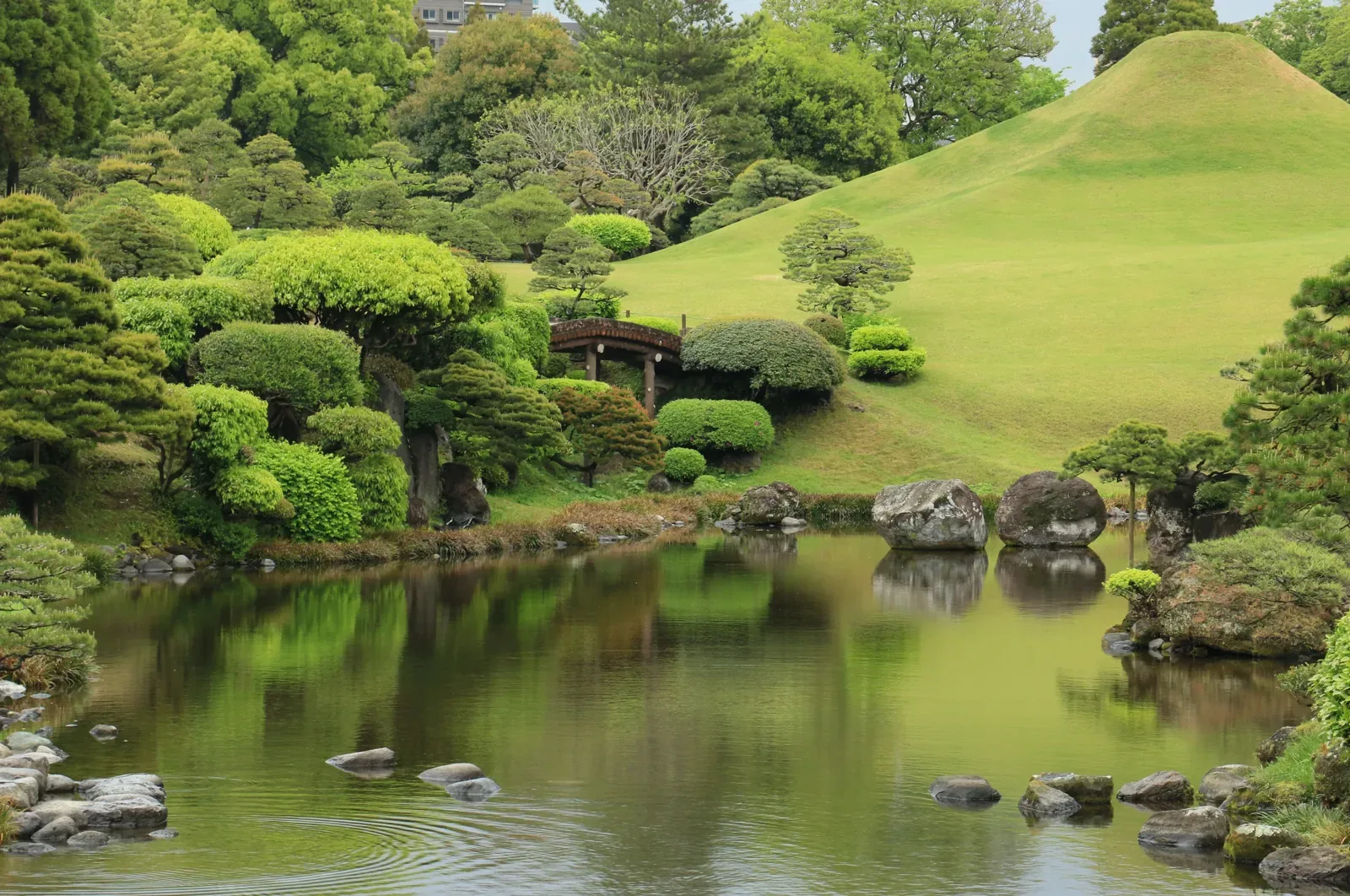
The pond at Suizenji Jojuen is fed by spring water off the volcano of Aso. It is a strolling garden, laid out in the early Edo period by the Hosokawa family, lords of the Kumamoto domain: the second lord, Hosokawa Tadatoshi, began it, and later generations brought it to its present form. Water is its soul, and Kumamoto's name as a city of water is literal here, in the spring welling up underfoot. Walking the pond, a visitor passes a hill shaped as Fuji and a landscape drawn from the fifty-three stations of the Tokaido. The garden miniaturizes a country, and it can be walked into.
Inside the grounds stands Izumi Shrine, dedicated to Tadatoshi and the lords who followed, and beside it the Kokin Denju no Ma, an elegant room that carries the tradition of waka poetry. That makes it more than a view: it is ground worked over by the Hosokawa family, by Shinto faith and by classical poetry. The open grounds hold a reception and can take a cultural performance as well, giving a group a stretch of time with real standing to it, between the spring water of Aso and the hill shaped as Fuji.
Suizenji's value is refinement rather than grandeur, a quiet dignity wrapped in clear water, green and the poetic tradition. Cherry blossom season is the most sought after, when the blossom at the water's edge and its reflection make one of the most affecting sights of the Kumamoto year. It suits guests who want an elegant reception inside the image Kumamoto lives by, without giving up cultural depth.