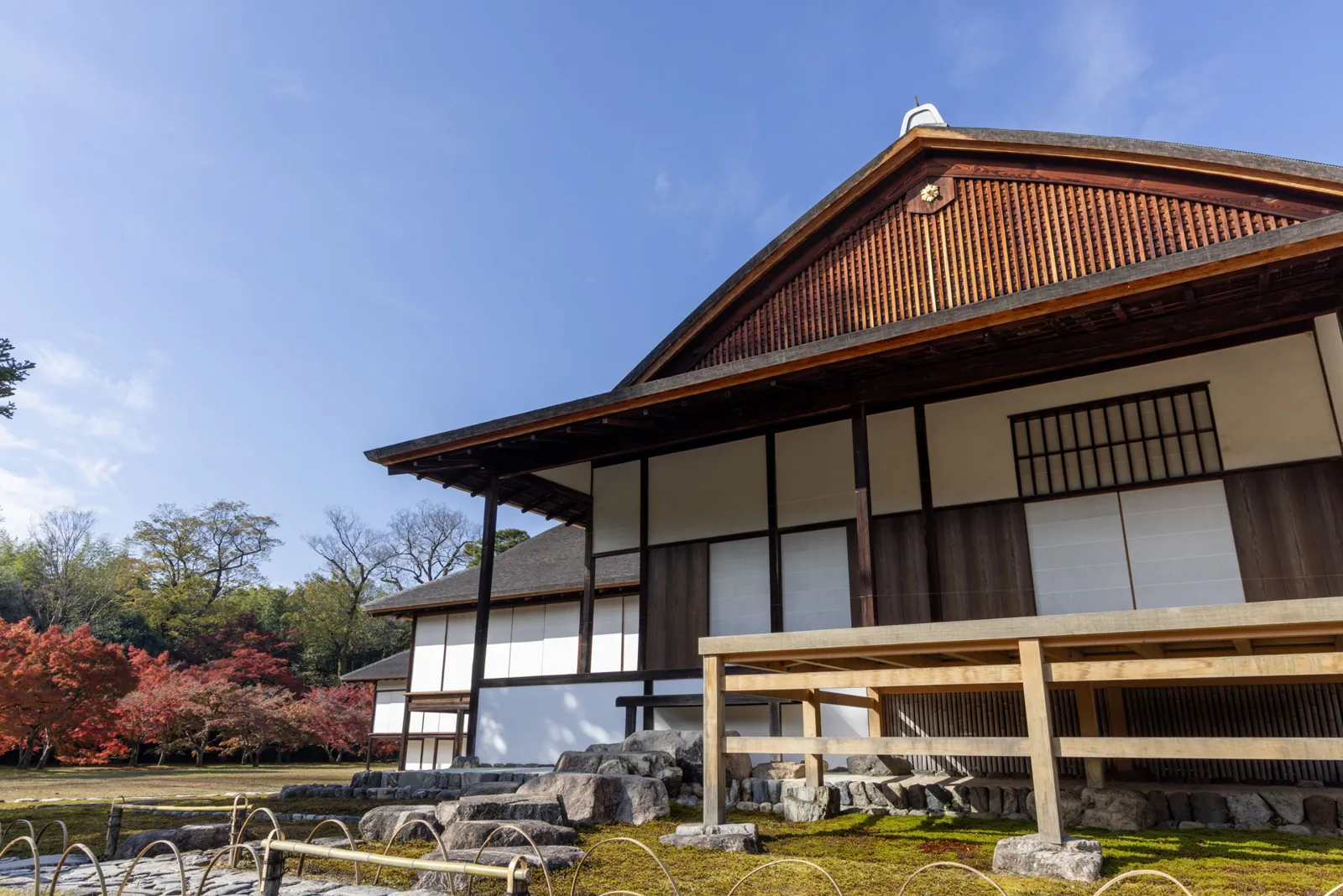
On the Katsura River in western Kyoto stands a villa built for an Imperial prince four hundred years ago. To this day, it can be entered only in the company of Imperial Household Agency staff.
It is the country retreat that Prince Toshihito, first head of the Hachijo-no-miya house, began building around 1615. The prince was a younger brother of Emperor Go-Yozei; as a boy he had been taken as a nominal son by Toyotomi Hideyoshi, and he went on to become the foremost authority on classical literature at court. His son, Prince Toshitada, took it over, adding the Middle Shoin to receive guests on long stays and raising the New Palace to welcome the retired Emperor Go-Mizunoo: two generations, about fifty years and three rounds of rebuilding, until it took its present shape around 1662. A monk of Shokokuji Temple who visited in 1624 left one line in his diary, in the original "the finest view under heaven". Later the German architect Bruno Taut called it "a world miracle of Japanese architecture".
The reason to build it into an itinerary on purpose is that the whole villa is in the service of the moon. Katsura has been famous for moon-viewing since ancient times, and the "Katsura-dono" of The Tale of Genji is set here. In front of the Old Shoin a moon-viewing platform juts out so that you can watch the moon in the sky and the moon in the pond at once; the Geppa-ro takes its name from a Chinese poem, "the moon reflected on the water is as beautiful as a single pearl"; in the New Palace, the transoms and the pulls of the sliding doors are made in the shape of the character "moon". At the mid-autumn moon of 1624, Prince Toshihito composed poems on the moon right here. Tell this thread to guests who can follow it, and an hour's walk through the garden becomes a Kyoto read in an entirely different way.
The difficulty is not price but places and rules. Admission is 1,000 yen for an adult, but total capacity is 480 people a day, 20 per tour, about 60 minutes, garden only (about 1 km); English tours, for foreign visitors only, run just 5 times a day. One application covers up to 4 people and must be made by the representative in person; applications from proxies, travel agents and related businesses are not accepted. Online applications open at 5:00 on the 1st of the month three months before the month of the visit, with a lottery when same-day applications exceed capacity. The moon-viewing evening held each autumn is narrower still: in 2025, 9,804 people applied and 64 were selected.
So getting in depends on the guest applying in person: online, by return postcard or at the counter, with a small number of same-day tickets as well. What deserves the care is before and after: when to apply, why it is worth it, and, once that hour's walk is over, how the rest of Kyoto carries this thread of the moon onward.
When is best: cherry blossoms in front of the Shoiken at the end of March, Kirishima azaleas in April, rabbit-ear irises (kakitsubata) in front of the Shokintei in May, and autumn leaves in November are all highlights that have been officially announced. What it pairs with: the same Imperial Household Agency application system also covers the Shugakuin Imperial Villa; the retired Emperor Go-Mizunoo came to inspect Katsura precisely because he was building Shugakuin, so putting both villas into one Kyoto trip sets one retired emperor against two landscapes. The Kyoto Imperial Palace needs no application and can serve as the prologue to this court thread.
Who it suits: architecture and design professionals, garden enthusiasts, and intellectually minded guests with an interest in The Tale of Genji and court culture. Children of elementary school age and younger cannot come along; the route includes narrow stone bridges without handrails, large steps and small slopes, so guests with limited mobility should be assessed in advance.