Dewa Sanzan maps a complete account of life and death onto three mountains. Haguro stands for the present world, Gassan for the past, or death, and Yudono for the future, or rebirth. Together they form a pilgrimage of dying and being born again that has been followed for more than 1,400 years. Mt. Haguro is the entrance to that journey and its center. Guests set out from the Zuishinmon gate and climb a stone stair through cedar that the Michelin Green Guide gave three stars: 2,446 steps, with cedars several hundred years old ranked on either side and sunlight cut into bands. People fall quiet and slow down without deciding to. This is not a climb. It is a rite entered one stair at a time.
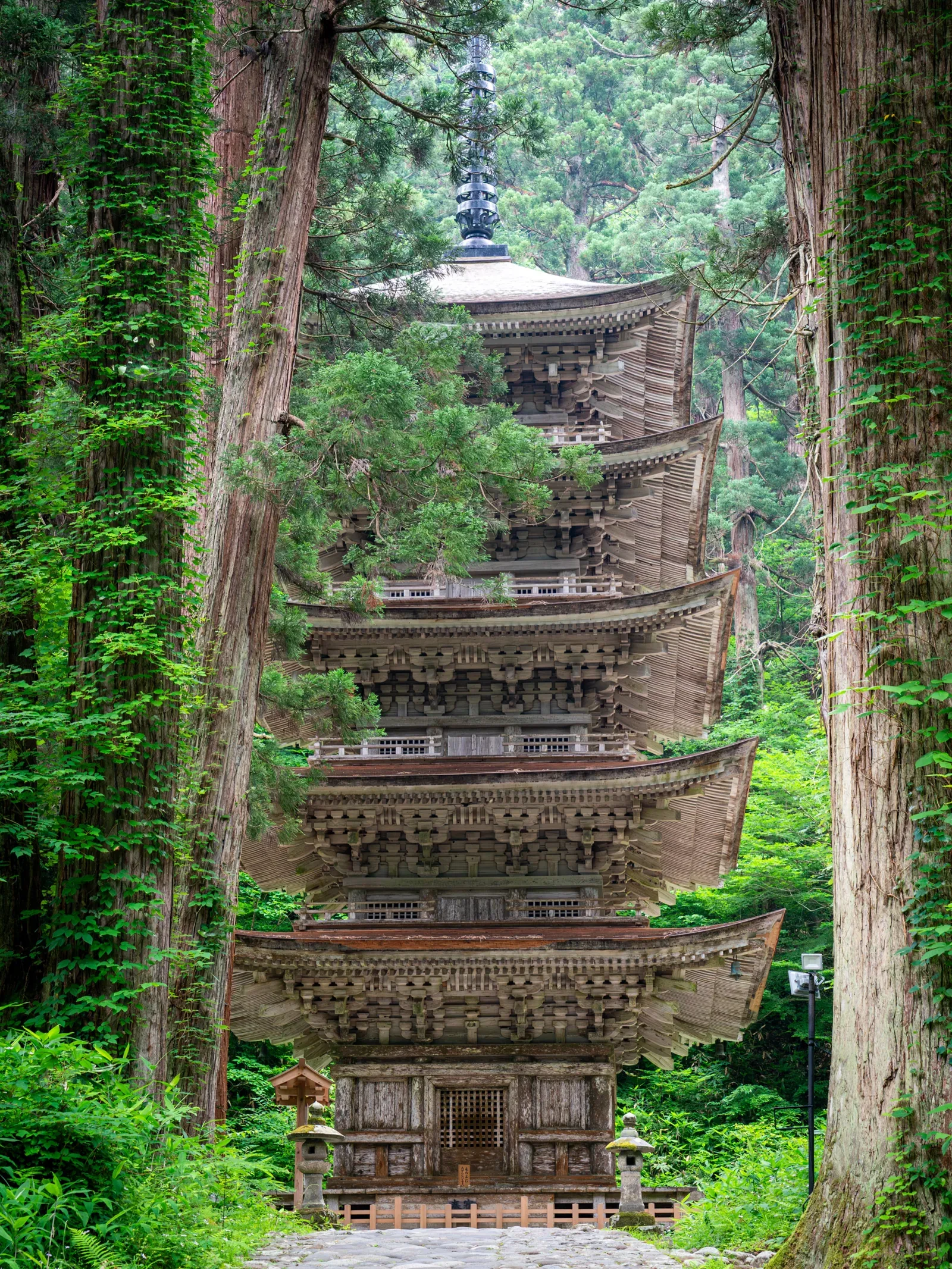
Partway up, a National Treasure stands quietly in the forest. The five-story pagoda of Mt. Haguro is about 29 meters high, plain unpainted wood under a shingled roof, built in the Muromachi period and the oldest pagoda in Tohoku. Without gilding or color, with nothing but timber and line, it belongs to the cedar forest around it, and that stillness reaches people directly. At the summit is the Sanjin Gosaiden, where the deities of Haguro, Gassan and Yudono are enshrined together. A visit here honors all three without climbing each in turn, which is what makes the pilgrimage work for first-time visitors and for groups with limited time.
It turns a valuable but hard-to-execute theme, spiritual renewal, into a route that can be walked, seen and understood. A National Treasure, a cedar path centuries old, three mountains enshrined in one place and a narrative of death and rebirth give it exceptional density, and it still fits into a day a beginner can manage. Combined with the onsen stay at Suiden Terrasse nearby, designed by Shigeru Ban, it makes one complete line: the sacred mountain by day, body and mind at rest by night.