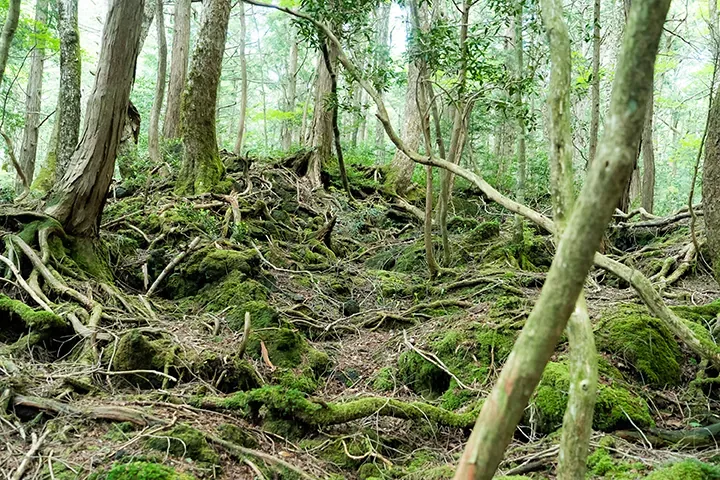
Aokigahara is a misunderstood forest: it grew back on lava from an eruption of Mt. Fuji. What the world remembers is the uneasy name and the sea of trees. Fewer know that life rebuilt this woodland inch by inch on a flow about 1,200 years old, which makes it a living account of what follows destruction. A guide certified by Fujiyoshida leads groups in. Underfoot is that lava, overhead a conifer forest a thousand years in the making, and along the way the caves the eruption itself formed. Mt. Fuji stops being a cone seen from a distance and becomes ground that can be walked into.
Two levels of tension are on offer. Course A covers about 4 kilometers in 4–5 hours through the sea of trees, with an English-speaking guide, a boxed lunch and tea, and asks no more than ordinary fitness: a walk on which a team goes quiet and goes in together. Course B is the step up, entering three wild lava caves in an area normally closed to the public, with the charge that comes of being taken somewhere off limits. Helmet, headlamp, gloves and rain gear are provided, for a maximum of about 30—the right number to put a team inside one unknown.
Mt. Fuji is the symbol every group wants, and most groups reduce it to a photograph. Here it becomes team building with depth, difficulty and a metaphor that works without help: the quiet of the forest, the dark of the caves, the story of regeneration, and a lesson about concentration and trust that no facilitator has to announce. Course B in particular sends an incentive group home with the one thing that cannot be bought elsewhere—they went where others cannot go, and they went together.