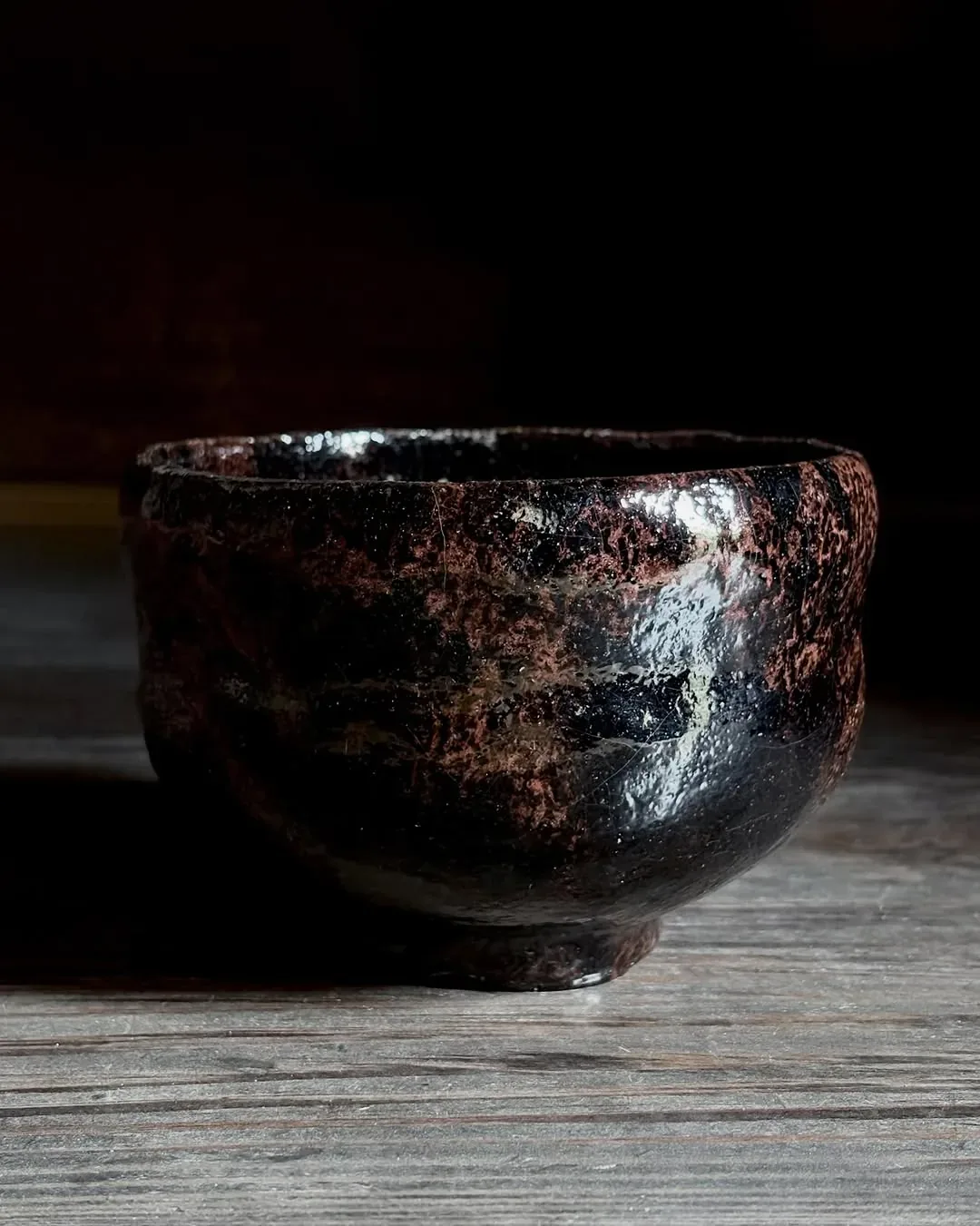
For 450 years one house in Kyoto has gone on firing the same tea bowl. The Raku family is the kiln of the first Chojiro, the potter to whom Sen no Rikyu entrusted his wabi aesthetic, beauty found in the plain and the incomplete. For 16 generations since Chojiro, under the name Kichizaemon, technique and spirit have passed to a single heir. Japanese ceramics has no higher name. No wheel is used; a bowl is formed with the hands and a spatula alone. Ornament is pared away, and out of fire, earth and silence rises the tea universe Rikyu was after, the here and now.
No studio is kept open to visitors. Access at this level runs through relationships: a private encounter with the world of Raku, quiet and one to one, with the aesthetic that 450 years of single-heir transmission have protected. No display case, no group commentary. In front of the real thing, a guest turns one question over: how the thought of wabi, carried by the single bloodline running from Chojiro, can live inside one tea bowl.
For collectors, and for guests who want a culture at the root rather than the surface, this is not recounted afterward as "we saw Raku ware in Kyoto." It is recounted as "we were invited to stand inside 450 years of Japanese beauty." A history no one can catch up to, a single bloodline, a door that does not open publicly: as the spiritual core of an itinerary, no bowl serves better.