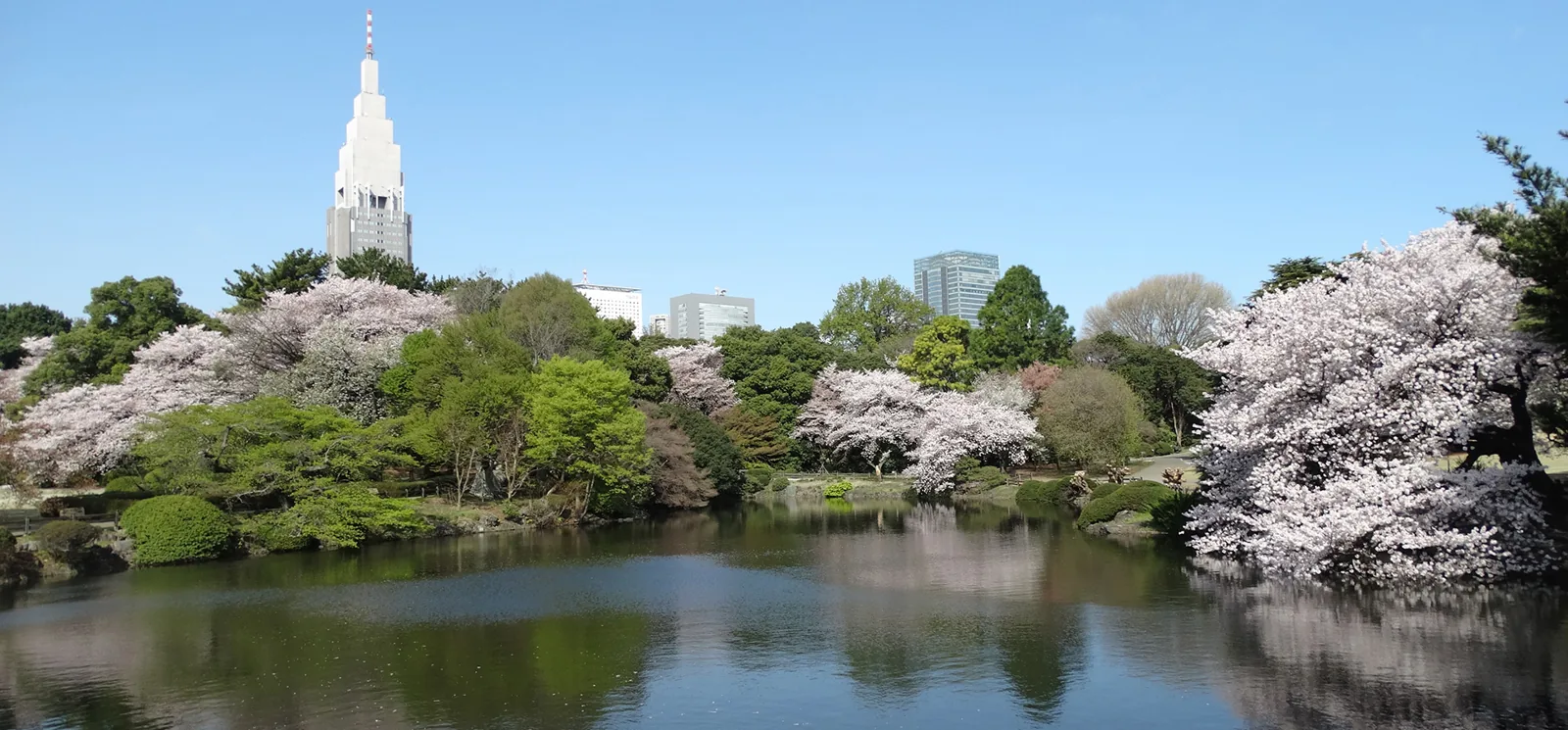
One set of grounds holding three gardens of completely different character.
Walk from one end to the other and the rules underfoot change three times. The stretch drawn by a French garden designer is formal: lines pulled straight, left matching right, your gaze taken by the hand and sent off into the distance, everything set down squarely. Then, as you walk, the rules loosen — grass rises and falls, trees have been left to grow into their own shapes, and the landscape garden has begun. Further in, the path stops sending you into the distance and lets you see only the few steps in front of you; you turn a corner and the next view is let out. That is how a Japanese garden is walked.
It was not made for strolling. The land was first granted to Naito Kiyonari, a retainer of Tokugawa Ieyasu, and was a daimyo residence; in the thirty-ninth year of Meiji it came into being as an imperial garden.
So three kinds of garden set side by side on the same piece of ground are not a designer failing to make up his mind. They are what an age had in mind — what Meiji wanted to do, what it wanted to become, left standing as a shape, and nobody has touched it since. You are not walking through a park. You are walking from one end of an era to the other.
The grounds are large; do not plan to go round them. Pick one gate, cross in one direction, and let the rules underfoot change for you one at a time. Coming out at the far end you notice that on that single walk three quite different ideas of beauty each took you part of the way — and that the people who once put them together meant it.