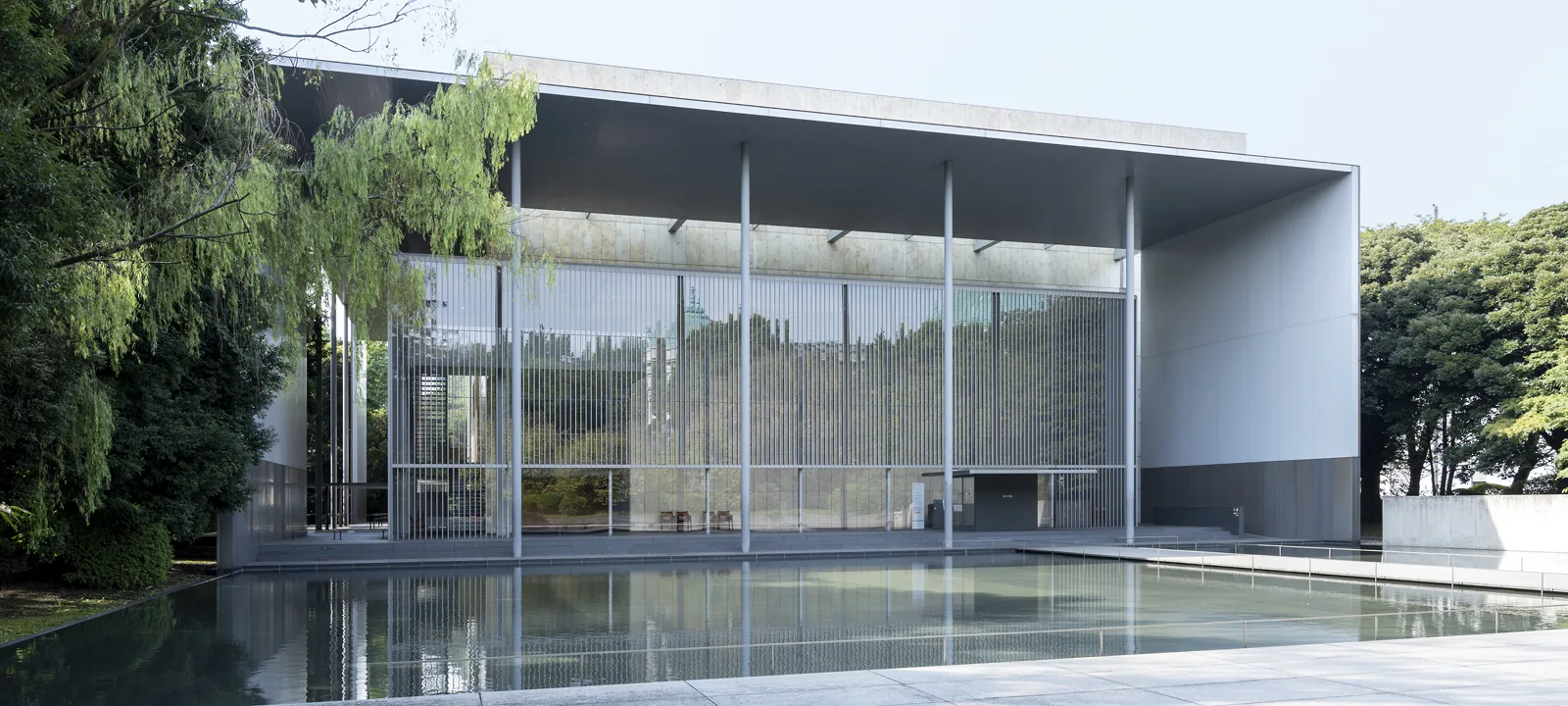
In the Tokyo National Museum's grounds in Ueno stands a building that hardly looks like a museum. A broad, shallow artificial pool lies in front; behind the water, a glass facade is screened by fine vertical louvers, with trees all around. This is the Gallery of Horyuji Treasures, designed by Yoshio Taniguchi and opened in 1999; its "bright exterior and hushed galleries" won the Architectural Institute Prize for fiscal 2001. Looking out at the pool through the glass from the first-floor entrance hall is something the museum itself recommends.
Inside are more than three hundred treasures that Horyuji Temple in Nara presented to the Imperial Household in the eleventh year of Meiji (1878), and which passed to the State after the war. In the museum's own words, they stand with the Shosoin treasures as the twin peaks of ancient art, but where the Shosoin centers on the 8th century, this collection holds many objects from the 7th century, an era earlier. In other words, a guest can stand before the Asuka period without leaving Tokyo.
The centerpiece of Room 1 is the National Treasure Kanjo-ban, a ritual banner: gilt-bronze plates pierced with honeysuckle scrolls, clouds, Buddhas and bodhisattvas and flying celestials, a canopy at the top with jeweled pendants hanging from its four sides, 551 cm long overall. The Agency for Cultural Affairs sums it up in a single line: nowhere else is there a gilt-bronze piece so old and so complete. It is believed to be the very kanjo article recorded in Horyuji's inventory of properties of 747. Beside it stands a replica made in 1999 to show the banner as it first looked; moving between the old and the new gives the thousand-plus years between them a scale. To protect the objects, the gallery lighting is kept low: the quiet here is by design.
The difficulty lies in which day you go. The 31 Gigaku masks in Room 3 include many Asuka-period masks, the oldest that survive; in 2025 they were designated National Treasures as a group. Gigaku itself is a performing art long since lost. The masks are shown only on Fridays and Saturdays each week; get the day wrong and the guest will miss them. Room 6 on the 2nd floor also rotates by period, so check what is on before going. The order of planning can only be this: fix the day of the week first, and everything else after.
What it pairs with: the Toyokan in the same grounds is the work of Yoshiro Taniguchi, Yoshio Taniguchi's father, so buildings by two generations of architects face each other across a courtyard. On the first floor, Sushi Kaiseki Okuno opened on September 30, 2026: an 8-seat counter plus one private room for 8, dinner by reservation only, and the restaurant says it set out to be a place "where one can dine at ease even after the museum has closed". See the Gigaku masks on a Friday evening, then sit down to sushi kaiseki in the same building: whether that sequence works, the details of the handover are to be confirmed locally.