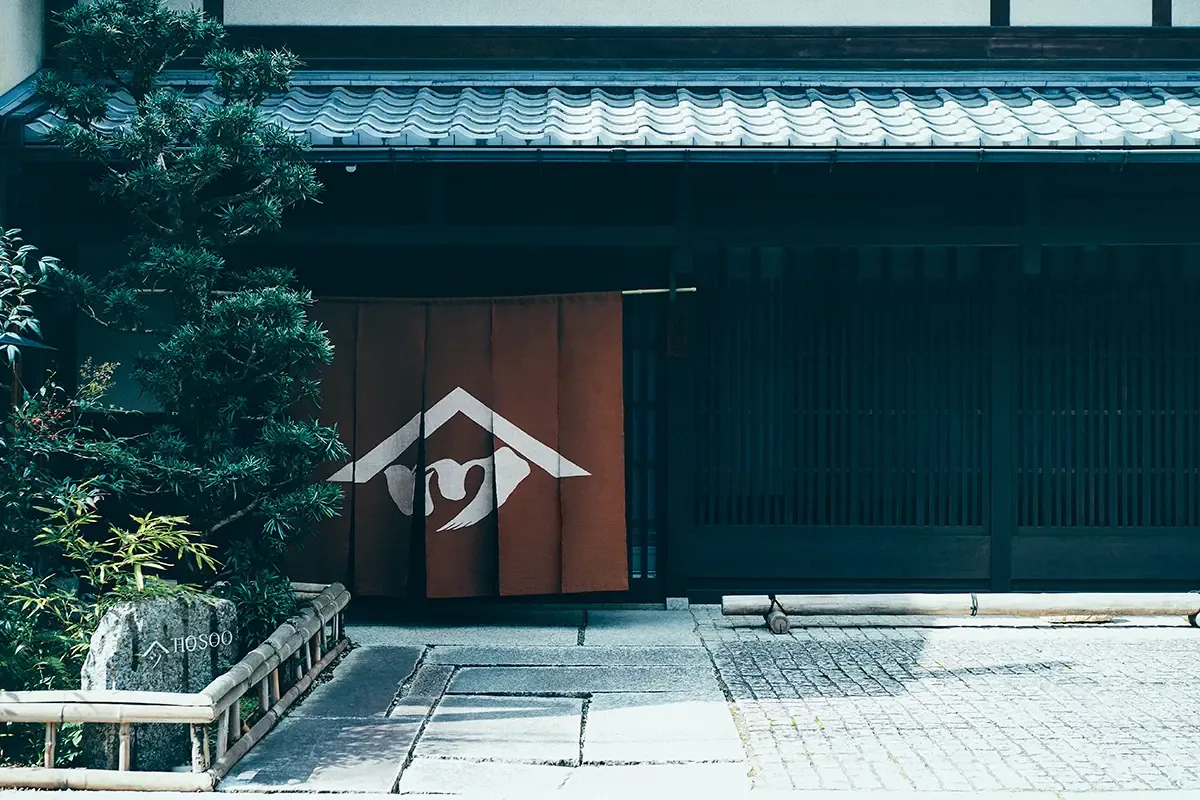
Nishijin has woven Japan's court dress and Noh costume for twelve hundred years. HOSOO has worked in that Kyoto district since 1688 and is now in its twelfth generation. What a guest can see here is the loom that pushed the traditional Nishijin width from 32 centimeters to architectural scale, where gold leaf, silver leaf and silk become, at the rhythm of the hand, a textile that covers a whole wall. It is standing on that threshold, crossed again and again between traditional craft and contemporary design, that lets you see how beauty in use has kept evolving for more than three centuries.
The Kyoto flagship store is where this happens, and we will not be coy about it: anyone can walk in. The ground floor is the store and the lounge, the second floor is the gallery, and any passer-by can push the door open to look at the cloth and at the loom.
What is rare is not getting in but getting upstairs. The third floor, HOSOO SALON, is described by the house itself as a members' area open strictly by introduction — a kimono showroom holding work by Living National Treasures, by full members of the Japan Kogei Association and by dyers and weavers from across the country, together with strong work from a younger generation. The fifth floor is a members' space as well, used for several purposes, and HOSOO RESIDENCE is currently marked membership only, with no ordinary booking. The house has divided itself in two: the lower floors belong to the world, the upper ones to those already inside the relationship.
The first and second floors can go into any Kyoto itinerary with confidence, as a stop where the craft is genuinely visible. In Kyoto some doors cannot be bought, only entered with someone who is already inside, and HOSOO draws that line more clearly than anyone.