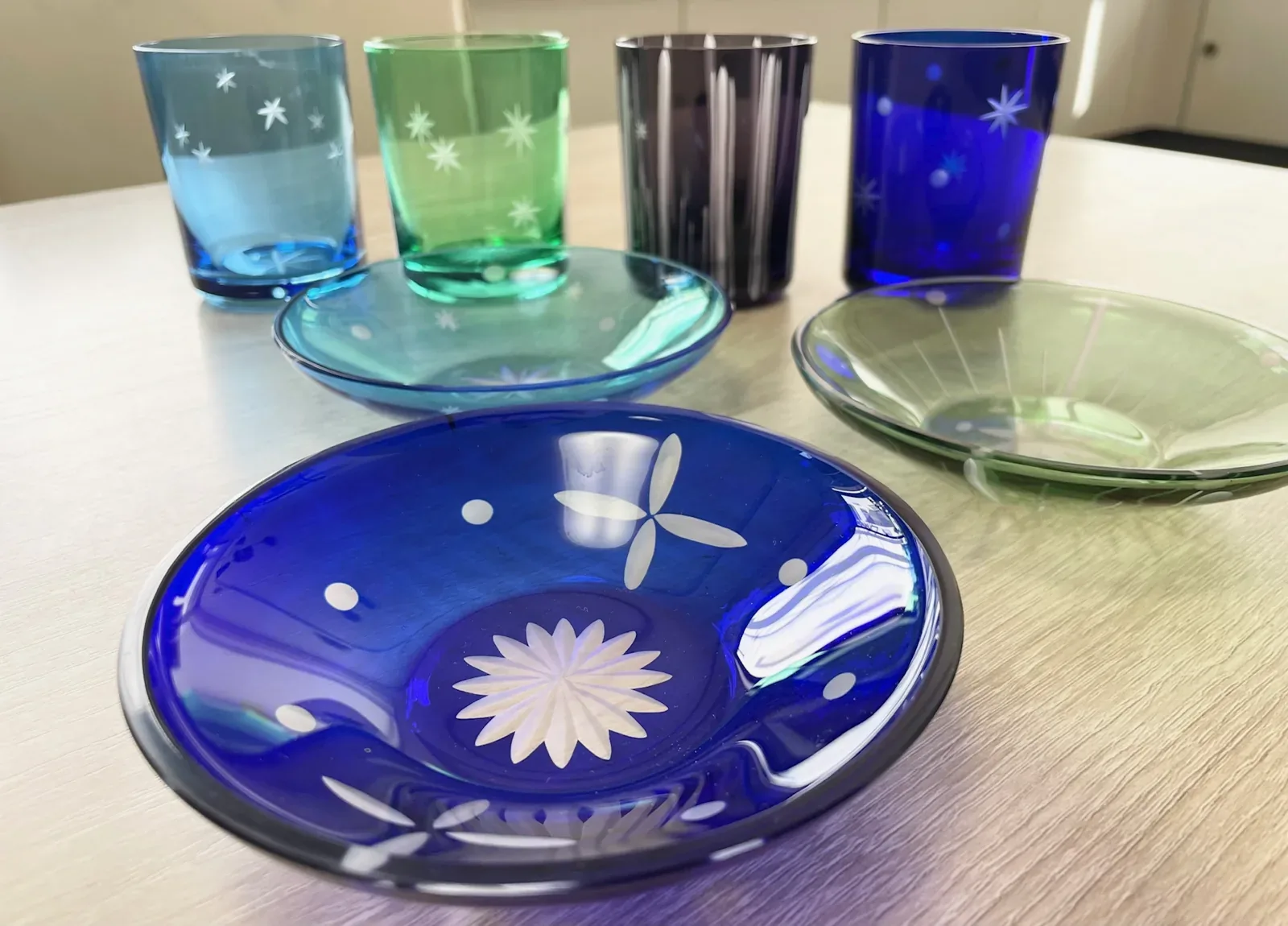
Nakakin Glass hands the guest a matcha bowl to cut, not the sake cup other Edo Kiriko studios offer. Edo Kiriko is Tokyo's own cutting craft, worked by hand with a grinding wheel since the Edo period, and Nakakin cuts it on a house blank it has used since 1946: clear glass sheathed in a layer of color. Every fraction the wheel removes lets the clarity underneath break through, so the work is less an incised pattern than light drawn out from between two layers. What to open and what to leave is the guest's decision, and the light and shade of the finished piece follow from it.
The bowl is a deliberate choice: larger than a cup, harder to hold on the curve, and every second the wheel touches the wall is held-breath work. What that earns is a piece that goes into a tea room and gets filled, a utensil that stays in use rather than a souvenir. About 90 minutes, ¥22,000 a guest, one artisan to one participant.
Tokyo's larger Edo Kiriko studios are better known and usually full. Nakakin's advantage is a table that is close to private: no line, no group, no glass case. For families and culturally serious guests who want to touch a real Edo craft quietly, what is on offer is time in the hands and a material no one else works.