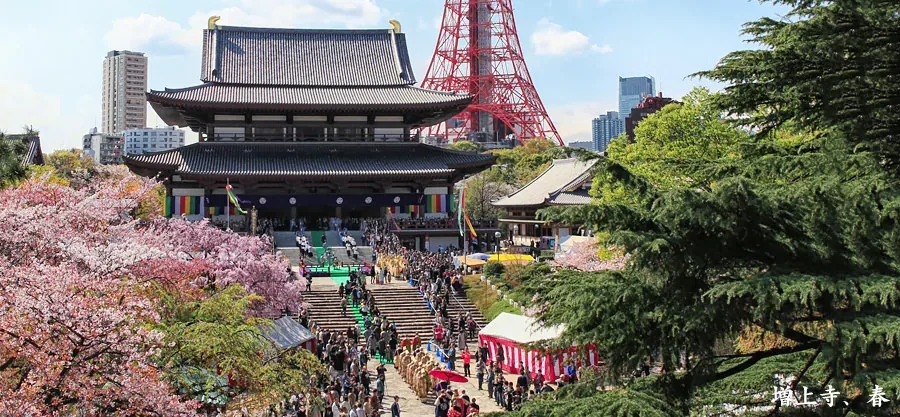
Zojoji is the Tokugawa family temple, and the temple itself is six hundred years old. The house of shoguns that founded the Edo shogunate placed what came after death in its keeping. In 1598, as Edo Castle was enlarged, Tokugawa Ieyasu moved the temple to Shiba, where it stands now. Six shoguns lie here: Hidetada the second, Ienobu the sixth, Ietsugu the seventh, Ieshige the ninth, Ieyoshi the twelfth and Iemochi the fourteenth, along with Princess Kazunomiya, who married into the shogun's house.
Zojoji is called the most photogenic temple in Tokyo, and the reason is plain at a glance: behind the halls, Tokyo Tower stands straight up. Wooden ridgelines carrying the Tokugawa memory, and a steel tower standing for postwar Japan. Nowhere else in central Tokyo do six centuries and the present day fit into a single frame. The moment guests come through the main gate they understand, from what is in front of them rather than from any commentary, how this country manages to live in tradition and in reinvention at the same time. That is what Zojoji can do.
What is scarce is not getting in, since anyone may walk the precincts; it is how much of the temple is whole in the years you happen to come. Two notices are up on the temple's own site at the moment. Viewing of the Tokugawa shogun mausoleum is suspended. And the Sangedatsumon, raised in 1611 with the shogunate's support by the line of Nakai Masakiyo, its master carpenter, and never lost to the fires that took so much else, an Important Cultural Property, has been under conservation work since 2025. Guests arriving now are looking at six hundred years under repair: the gate comes out of its scaffolding some years from now, and the mausoleum waits for the temple to open it again. Anyone who has seen the whole of it happened to come in a particular year.
Both depend on the temple's current arrangements. The Daiden, rebuilt in 1974 after the wartime fires, and the frame that holds it together with Tokyo Tower, are there on any day. An evening performance or a reception inside the precincts is a different matter. The temple publishes no venue conditions, no fee and no application window, so it is arranged case by case, on inquiry.