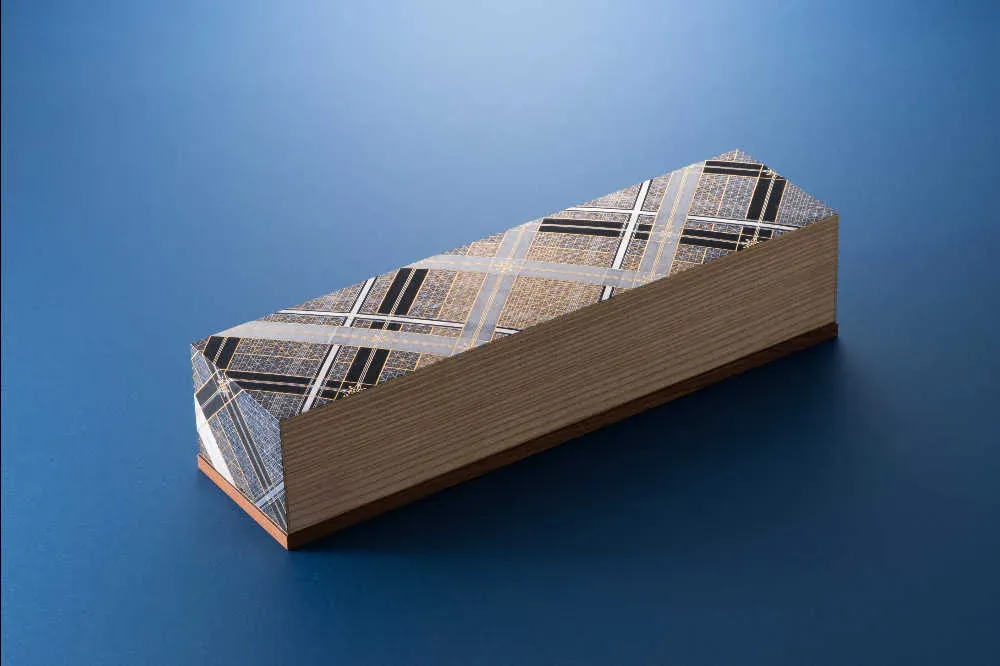
Kirikane cuts gold leaf into lines finer than a hair, then lays them down one strand at a time. It was used to adorn Buddhist images and sutra boxes, and of all the Buddhist arts it comes nearest to writing with light. There is no pigment. The pattern is not painted on; it is set down, strand by strand, out of the gold itself.
Eri Tomoko was born in Kyoto in 1972, the daughter of the Buddhist sculptor Eri Kokei and of Eri Sayoko, who in 2002 was designated a holder of the Important Intangible Cultural Property kirikane, the recognition Japan calls a Living National Treasure. In 2001 she moved to Fukuoka, her husband's home province, and has worked between Kyoto and Fukuoka ever since. She took the Japan Kogei Association's newcomer prize in 2011, a Kyushu Asahi Broadcasting prize in 2013, and the Kyoto Prefecture cultural encouragement prize in 2020.
Her kirikane is not in a display case. It is overhead, where anyone in the room looks up and sees it. The three principal works her own site lists are all ranma, the pierced transom panels set above the sliding doors of a Japanese house: Ki-Mei for a residence in Ishinomaki in 2009, a four-seasons transom in Kyoto in 2010, and a phoenix transom for the Fukuoka restaurant Sagano in 2011. A transom is the band that lets light over the lintel; as the sun swings through the day, the gold lines light up in turn. This craft does not end up put away. It ends up lived with.
The rarity is not that there is a door with an invitation on it. Kirikane is a nationally designated Important Intangible Cultural Property, and only a very few people are ever recognized as holders of it at one time; the designation of Eri Sayoko in 2002 was one of them. Tomoko grew up in that house and carries the work forward. This is not a sight to slot into an itinerary. It is a line that is still alive.