Noh has been performed without a break for some 650 years, since the Muromachi period. It is designated an Important Intangible Cultural Property and inscribed on the UNESCO list of intangible cultural heritage. Its means are pared down almost to the point of severity: the actor puts on a mask and, through highly stylized movement reduced to the barest minimum, pushes human feeling out to where it can be seen.
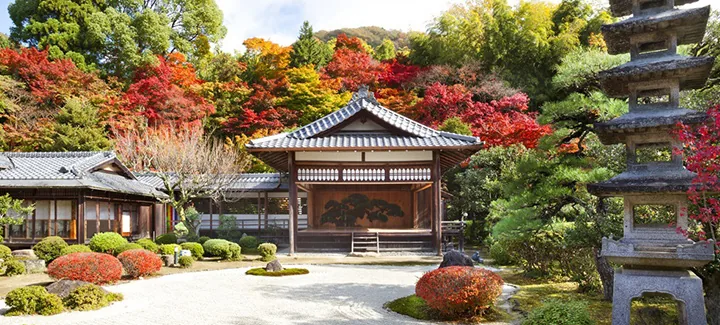
The form of the Noh stage is itself part of the art. A bridgeway called the hashigakari joins the stage to the dressing room, and it is not merely an entrance; it has long been read as the road that links this world to the world of spirits. The moment when the actor puts on the mask in the kagami no ma, the mirror room, and comes out along that bridge is one of the most carefully weighed passages in all of Noh.
On a stage inside a private residence, what changes is not the repertoire but the distance. A mask such as the ko-omote is said to carry a chukan hyojo, a middle expression that leans toward none of joy, anger, sorrow or delight; everything rests on the actor tilting it a few millimeters up or down, teru for the lift and kumoru for the drop, and the whole face changes feeling inside that angle. From the seats of a public hall this cannot be made out. On a house stage it happens within a few meters. Putting this passage into an itinerary gives the guest not a seat but nearness.