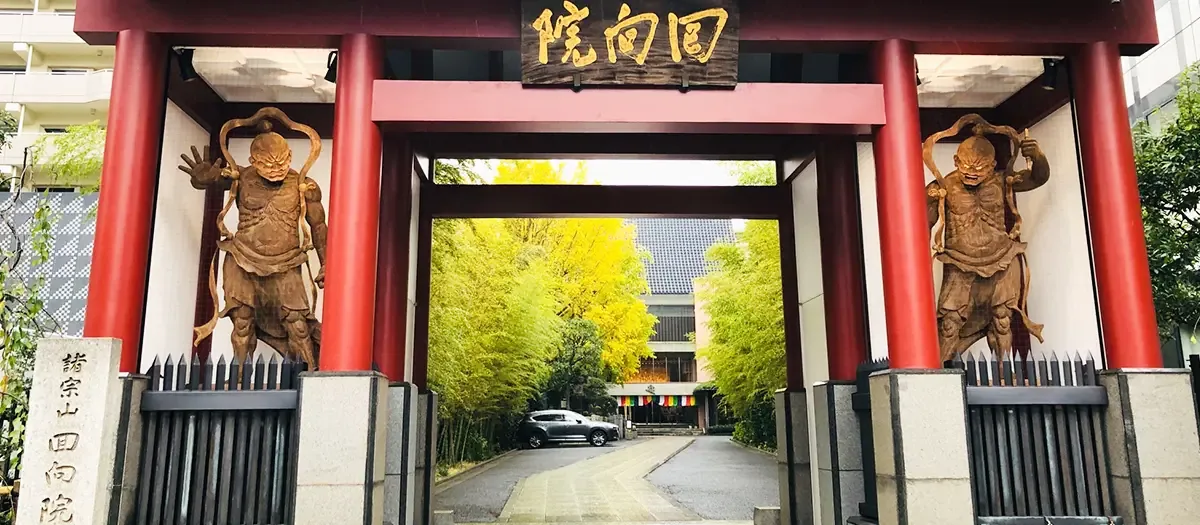
In 1657 the Meireki fire burned away most of Edo. More than a hundred thousand people died, and a great many of them were never claimed. The shogun of the day, Tokugawa Ietsuna, ordered a great memorial service for those unclaimed souls, and a hall was built for it. That is where Eko-in begins. It is not a temple raised for a distinguished family; it was raised for the people nobody was left to bury.
Later it became a station on pilgrimage routes, and by the late Edo period it was the site of kanjin sumo. Today the Kokugikan stands a few steps away — the reason sumo lives in Ryogoku begins at this temple. That thread only joins up when the guest is standing here: first a talk from the priest in the main hall, then a walk out to look at the Kokugikan, and suddenly the two are one thing.
The spaces are practical. The ground floor of the Nenbutsudo takes a seminar or an exhibition (81 sqm, 50 seated), and the Kyakuden above it takes a dinner (76 sqm, 60 seated). The Nenbutsudo is itself a 2013 building, traditional in style and contemporary in construction.