In this country the Japanese sword has never been only a weapon. It has been treated since antiquity as a work of art and enshrined as a symbol of samurai culture. The value of a blade lies in the hamon, in the jihada, in the barely legible grain that appears when light falls across it — and none of that has anything to do with whether it could kill. There is no way to understand this except by standing in front of a real one.
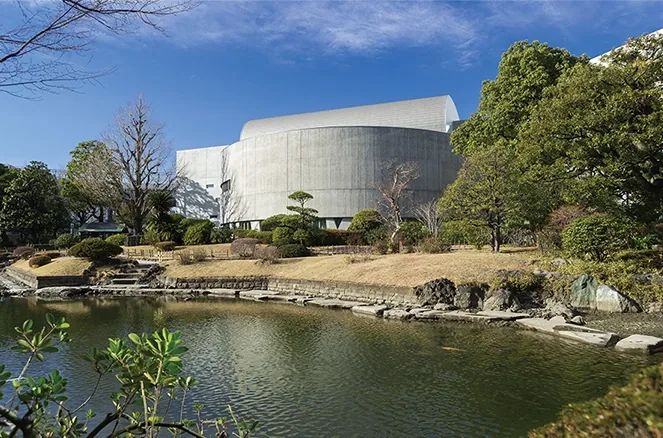
The Japanese Sword Museum moved to Ryogoku and reopened in 2018, in a corner of the former Yasuda Garden, in a building by Fumihiko Maki, a leading figure of Japanese modernism. The collection holds rare blades that cannot be seen elsewhere. So the address gives three things at once: the swords, the garden, and a piece of contemporary architecture worth looking at.
The spaces are practical: Lecture Hall 160 sqm (60 seated, 100 standing), Cafe Space 86 sqm (30 seated, 60 standing), Exhibition Hall 304 sqm (50 standing). A group under a hundred can take a talk on swords in the lecture hall first, then move into the exhibition hall to raise a glass among the blades.
The Kokugikan, Eko-in and Edo NOREN are all within walking distance.