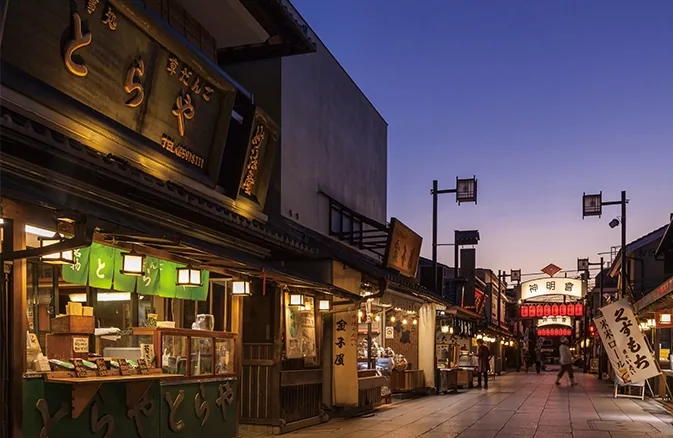
Shibamata in Katsushika was the first place in Tokyo designated an Important Cultural Landscape. The title goes not to a single building but to an entire street that is still alive. Along the 200 meters of approach from Shibamata Station to Taishakuten, shops carried down from the Edo period stand shoulder to shoulder: river fish restaurants, kusa-dango, rice crackers. They are not a reconstructed set. They are shops still doing business.
That makes the way this street is used unusual. The whole approach can be taken (700 sqm, 500 standing), or the dinner can be scattered across the shops — Kawachiya at 1,800 sqm for 500, Monzen Toraya 396 sqm for 120, Yebisuya 200 sqm for 130, Kameya-honpo 220 sqm for 100, Takagiya-rouho 132 sqm for 80. A party of five hundred can be split into five dinners of different character, or brought together to fill the street entirely.
The value sits here: almost every old-town experience in Tokyo consists of taking guests to look at something, whereas this hands the street itself over to them. Walking the approach, the shopkeepers on both sides know each other and know the guests — that atmosphere cannot be staged, only borrowed.
It pairs naturally with Daikyoji, the temple at the end of the approach: eat and browse along the street, then enter the temple for the carvings and the garden. And for a large party it does the rare thing of solving both scale and warmth, requirements that usually pull against each other.