A pottery session usually begins with a lump of wet clay. You sit down, the clay is already there, and nobody asks where it came from.
Here they want you to begin with a stone.
The stone is Hanasaka pottery stone, quarried from the hills of Komatsu. It is crushed, steeped in water, washed through again and again, and then simply left to settle — what you watch is the water clearing by degrees while something as fine as cream gathers underneath. That is the clay that will shortly be turning in your palms. This seido kojo, the clay-making works, has been running on this ground for more than sixty years; the part of Kutani-yaki that begins with earth begins here.
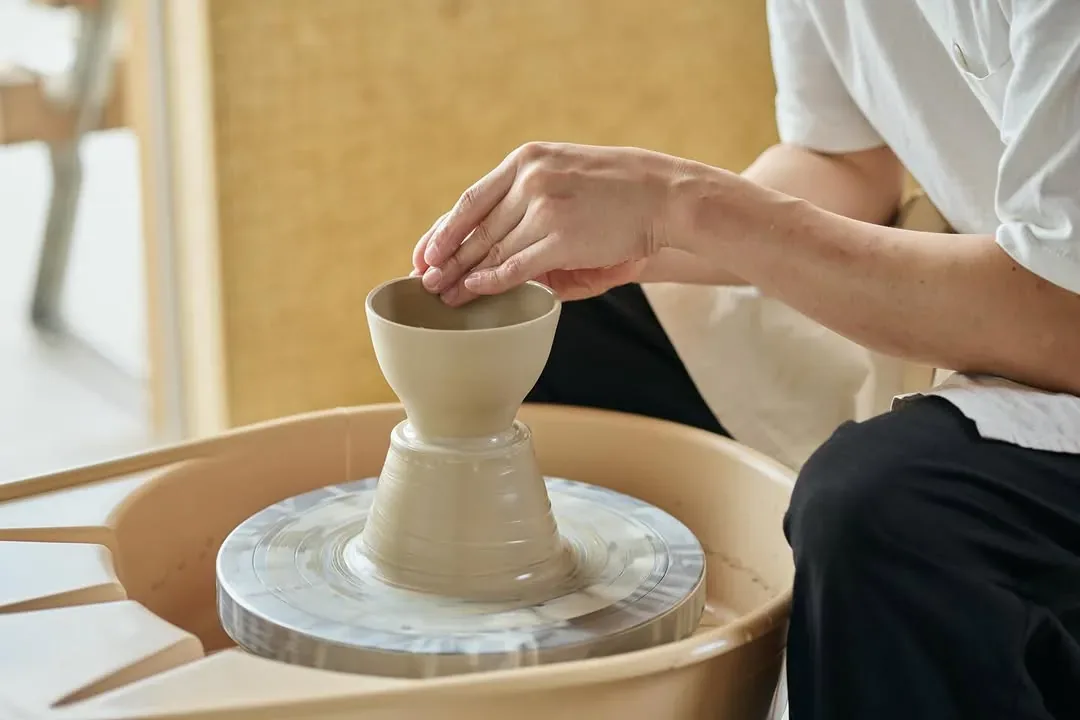
Only then do you sit down at the rokuro, the wheel. Press a little and the clay leans; ease off and it runs away from you. When it finally stands up, it is time for the colors: red, yellow, deep blue, green, purple. The brush goes down thick enough to look almost lit from within — these are the colors by which anyone recognizes Kutani-yaki at a glance.
Someone who has watched stone become clay reads those brushstrokes differently. They are no longer merely handsome; they are the geology of this place grown into color. More than three hundred years ago someone here recognized what this stone could be made to do. The chain has been turning ever since, and you have just put a short length of it in with your own hands.
The city of Komatsu puts it plainly: clay-making, forming, the raw body, the overglaze painting — not one of Kutani-yaki's techniques is missing, and all of them sit on this one piece of ground. What gathers the whole sequence under a single roof is a building by Kengo Kuma, so even someone in your party with no interest in porcelain has something of their own to look at.
You leave carrying a vessel you pulled off center and then coaxed back. What stays longer is a question: from now on, wherever you pick up a bowl, you will want to know which earth the color came out of.