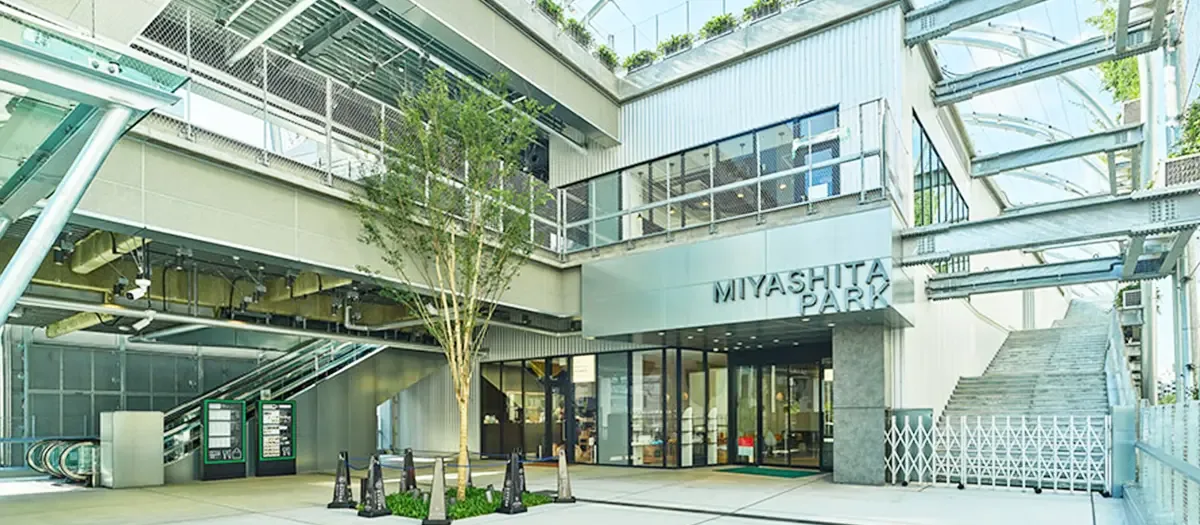
Shibuya has stacked itself up.
One building: a yokocho — an alley of small bars and eating houses — along the bottom, shops in the middle, and a lawn held up on top. Stand on the lawn and Shibuya runs past below your feet. Turn and go down, and you pass first the windows of the luxury houses, then, lower, the signs of the street labels set one against the next; at the very bottom the yokocho lights are on, glasses knock together, and the music bar next door has just opened for the night. These things are normally scattered across Shibuya, with little regard for one another. Here they are lined up along a single street, and walking it end to end takes hardly any time at all.
It began as an ordinary park, opened in 1953. In the sixties someone lifted it onto a roof, and it became Tokyo's first rooftop park. What that lift changed was not the height. It was how many ways of living one piece of ground could hold at once.
Which is why the order matters: go up first, then come down. Look at it first, then soak in it.
The lawn on the upper level is for looking. What Shibuya is like by day, where the people are going, how the buildings press against one another — you take it all in from here at a glance. When you have had enough, drop down into the yokocho, sit in among the crowd, have a drink. Early evening is the best hour: the shops are all open, the light is going, and the yokocho's night is only starting — the restaurants stay open very late.
Most people who come down from the top carry away something they cannot quite put into words: that Shibuya is not a place the word "chaotic" covers, it has simply crowded too many ways of living into one spot. And you have just walked through them, top to bottom, in the height of a single building.