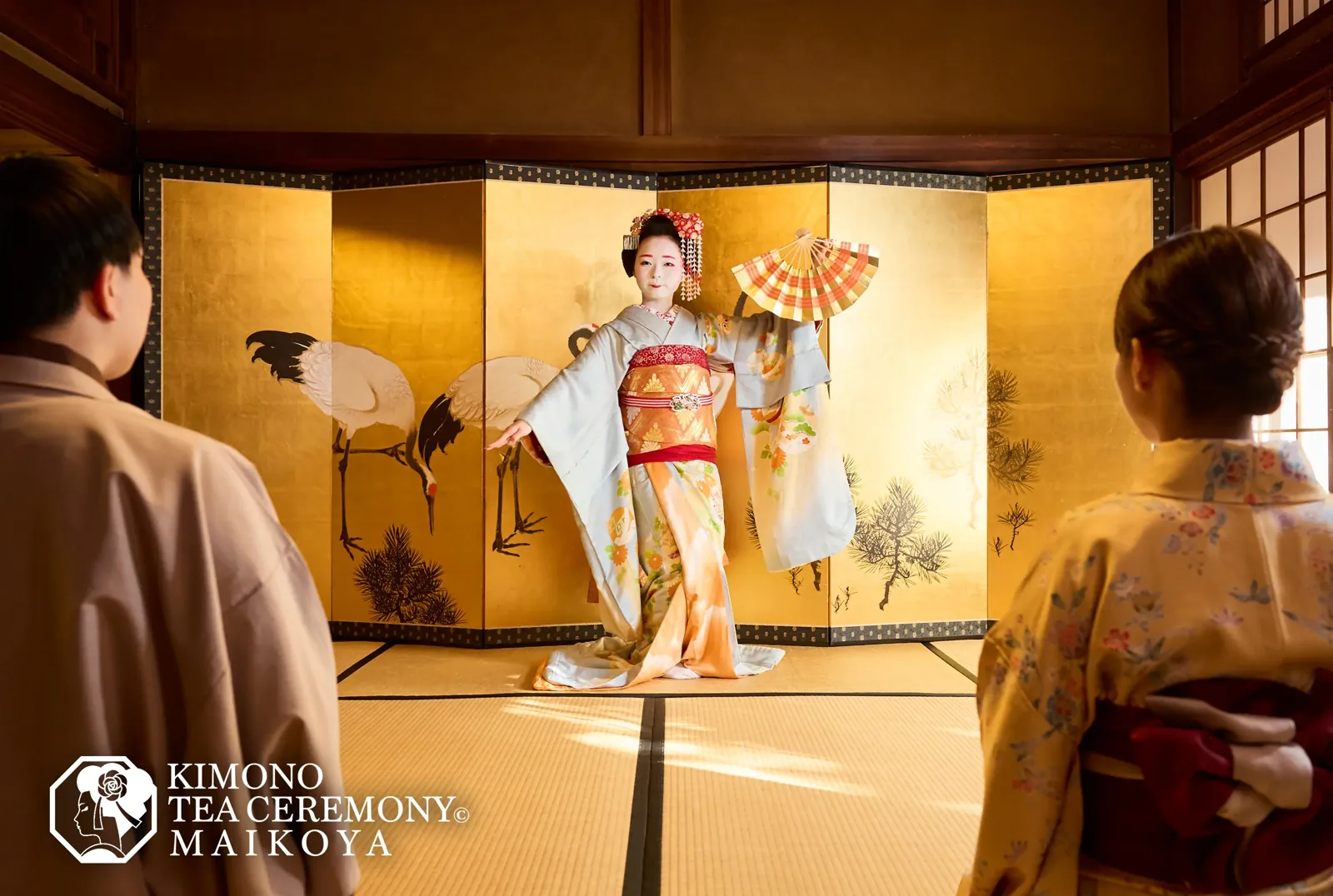
A maiko's day starts in the late afternoon. The ozashiki — the private tatami room where she is engaged — is her place, and for most visitors the whole of their encounter with her comes down to a back hurrying along a stone lane at dusk, or a photograph taken too late to make out the face.
This one puts the meeting in daylight. Noon light slants into the ozashiki, the tatami is warm from the sun, and the first thing to arrive is a midday meal of Kyoto cooking — then the paper doors slide open and she walks in.
A maiko by day is not the maiko of the evening. No lanterns, no smell of sake, no sense of a performance held at a distance. She dances a kyomai, a Kyoto dance, close enough that you hear the sleeve of her kimono sweep the tatami; then she sits down and plays a round of ozashiki-asobi with you — the parlor games of the hanamachi, the geisha districts, unchanged for centuries. The loser pays a forfeit, and she will mostly let you win.
Then you begin to ask her things. How heavy the hairstyle is; what hour she gets up to have it dressed; how long she must go without washing it. What age keiko, her training, began. Which rules belong to which season in the hanamachi, and must not be got wrong. She answers them one by one, like a girl of seventeen or eighteen talking about her work. And that is the real difference between the day and the night: after dark she is an image to be looked at; by day she is sitting across from you, a person with a particular trade and its particular hardships.
Only two to eight people sit at this table, so her attention really does reach each of them — including the smallest. What a child remembers is rarely how beautiful the kimono was; it is that she spoke to me. Someone who would otherwise have existed only in a photograph turns back into a person. That is what these two hours actually leave you with.